Showing posts with label accessibility. Show all posts

Tuesday, 24 January 2017

Ruislip on the Map

Pic of lady's hands holding small London tube map on platform as tube passes

'Where is Ruislip?' This question has been raised so many times that I thought I had better answer it in a blog, especially for my international contacts. Ruislip is very accessible and is surprising close to many places you all know well. It is in the London Borough of Hillingdon with Heathrow airport just 15 minutes away by car. Hillingdon is the white area to the west on the map below.


ACCESSIBILITY
My nearest underground station is South Ruislip. This station is two stops before the end of the Central Line into central London. This gives me direct access to:
  • Oxford Street shopping and businesses
  • Soho's creative sector
  • Holborn for the French Chamber of Great Britain
  • Chancery Lane for the legal sector
  • Liverpool Street and Bank for the City of London and the financial sector.
Pic of Ruislip Manor station and railway bridge with its name from opposite side of streetUnderground Connections
Ruislip Manor and Ruislip Stations give access to both the Piccadilly and Metropolitan Lines. South Harrow via 114 bus is another option for the Piccadilly Line. 

This is an important connection for the French Institute, Imperial College London, a large French community and famous museums in South Kensington.


Railway Connections
South Ruislip also has access to Chiltern Mainline. This means that I have easy access to:
  • Wembley Stadium and business park
  • London's Marylebone station in around 20 minutes.
  • Euston and King's Cross to change to tubes for mainline UK routes to the north of London
  • Most importantly, Eurostar connections from St Pancras International Station to Paris, Brussels, Lille, Amsterdam, etc.
  • The Chiltern Line was extended to Oxford in December 2016.
Accessibility will improve even further once Crossrail or the Elizabeth Line opens. Ruislip is also part of the planned route for HS2.

Road Connections
Ruislip offers easy access to a number of motorways:
  • M40/A40 into Central London going east; Oxford and Birmingham heading north-west.
  • M25 London's orbital motorway to Gatwick Airport.
  • M4 corridor is the base for a number of IT companies heading towards Maidenhead (the Prime Minister's Constituency), Reading, Swindon, Bath, my native city of Bristol and Wales.
  • M1 for Luton Airport and the Institute of Translation and Interpreting (ITI) at Milton Keynes.
Local Business Meetings
For local business meetings the Ramada London South Ruislip Hotel is within walking distance of South Ruislip Station and my home. Manor Farm and Winston Churchill Hall also offer conference and theatre facilities.

MEANING AND PRONUNCIATION
Ruislip’s name probably comes from Old English words for "rush" and "leap", meaning a place where the local river Pinn was narrow enough to jump across.

Ruislip is not pronounced as it looks. My apologies to non-native English speakers! 

[ˈraɪslɪp]
Pronounce the first 3 letters as you would the cereal crop 'Rye'. Audio

HISTORY

Pic of grass mound and moat site of ancient motte and bailey with manor house in background
Ruislip dates back to Saxon times, when Manor Farm belonged to the landowner, Wlward Wit. Following the Norman Conquest in 1066, his land passed to a new Lord of the Manor, Ernulf de Hesdin.


Manor Farm House was built in 1508 and is still standing today. The lordship of Ruislip Manor passed to King's College Cambridge in 1451.


Pic of Ruislip Manor House
Ruislip Manor Farm House

LOCAL MPS
The local Member of Parliament (MP) for Uxbridge and South Ruislip is Boris Johnson. He is the former Mayor of London and is now the UK's Foreign Secretary. 

The MP for Ruislip, Northwood and Pinner is Nick Hurd. He is the Minister of State for Climate Change and Industry within the Department for Business, Energy and Industrial Strategy (BEIS). He is the eldest son of Douglas Hurd, former Foreign Secretary under Margaret Thatcher and John Major.


Karen Andrews is a freelance French to English translator, transcreator, content writer and editor. She has a strong background in global marketing.

Email Karen for further information via karenanglicityen@gmail.com in French, German or English.

Thursday, 5 January 2017

Double Shakespeare

Pic of outside of Theatre Royal Haymarket with banner for Love's Labours Lost

A Time Out magazine special offer gave me the opportunity to see two Shakespeare plays in the New Year break. The Royal Shakespeare Company are playing a double bill of Much Ado about Nothing (or Love's Labour's Won) and Love's Labour's Lost.


Much Ado about Nothing is one of my favourite Shakespeare plays. I first saw it performed by the Royal Shakespeare Company at Stratford with Derek Jacobi as Benedick and Sinéad Cusack as Beatrice. Love's Labour's Lost was new to me apart from a few snippets. The versions at the Theatre Royal Haymarket bring the plots forward in time to periods before and after the First World War.


Much Ado remains a timeless classic for me. It doesn't matter that all the funny lines are well-known and anticipated in advance. I still laugh at the repartee between Benedick and Beatrice. It took me rather longer to warm to Love's Labour's Lost. I'm afraid that I found much of the early banter immature and irritating. The play was simply too wordy for my tastes. Too much word play eventually becomes tiresome, especially when the language has dated. Having said that, I did enjoy the role of the overly pedantic schoolmaster immensely.


The country house set is used to great effect in both plays. The Much Ado set even boasted a Christmas tree. It provided Benedick's hiding place in his famous eavesdropping scene. 


Scenery as seen from upper tier
The RSC's Much Ado About Nothing set with Christmas tree

It was amazing to watch how the elaborate scenery slid in, out and across the stage to create different settings both inside and outside. It made an interesting contrast with the digital scenery that I saw last year at the Barbican and in Paris.


Pic of stage before start of performance
The RSC's opening set for Love's Labour's Lost

For Love's Labour's Lost, I enjoyed being much closer to the action in the Royal Circle, whereas my head was up with the chandelier for Much Ado.


Chandelier as seen from Upper Circle at the Theatre Royal Haymarket

A number of theatre-goers seemed to have difficulties with the alarmingly steep slope down to seats. After the steep climb to the Upper Circle, it made you dizzy to look down. The usher was available to hold your hand if required. Still, I was surprised that there wasn't even a handrail for elderly visitors to hold on to, especially given stringent health and safety rules these days. I did note that audio equipment was available for the hard-of-hearing. 


The Theatre Royal Haymarket looks great from the outside, but inside it could do with some modernisation. There would probably be fewer  empty weekday seats if the elderly felt comfortable reaching and leaving their seats. It's hard to see how some of London's more ancient theatres can be updated to modern accessibility standards.


I have always loved the way that Shakespeare mixes tragedy in comedy and comedy in tragedy. It seems much more true to life that way. Still, the end of Love's Labour's Lost catches you by surprise. The death of the Princess's father brings the merriment to an end. It is chilling to see the four male suitors dressed in military uniforms at the end. It leaves you regretting your earlier irritation with them and fearing for their fates in the bitter war to come. Comedy over.


Karen Andrews is a freelance French to English translator, transcreator, content writer and editor. She has a strong background in marketing and project management.

Email Karen for further information via karenanglicityen@gmail.com in French, German or English.


Saturday, 31 December 2016

Welcome 2017

Picture of words Welcome 2017 with bit of Christmas tree underneath


I started my event list blogs at the end of 2015. The posts snowballed in 2016 in response to popular demand. I moved from an annual post to monthly posts. As London gained its first Muslim major in Sadiq Khan in 2016, I noted how it was possible to make my event lists an example of cultural diversity and inclusion.

Original intention
My original intention was simply to bring together a wide range of sources for my own diary. I could see the benefits of sharing my efforts with others. I was amazed at how many events take place within the translation industry. I was also conscious that many were not keen to promote the activities of rival organisations.

Active, Energised Sector
I saw the benefits of promoting an active and energised translation sector to potential clients and the outside world. It is not possible to attend every event. We can consult the programmes and gain an awareness of what is happening in our industry. Good ideas are shared by other colleagues and countries.

Change
When I started out as a freelancer many within the translation industry regarded marketing and social media somewhat dubiously. It has been interesting to see others actively promote themselves and their organisations in similar ways.

Cultural Diversity and Inclusion
As cultural competence is so important to good translation, I started including more and more cultural events. Along the way, it has become a labour of love motivated by my firm beliefs in cultural diversity and inclusion.

Remaining Connected
Brexit came as a huge shock. It became more important to stress a desire to remain European and globally connected.

Access to Multicultural Events
My modest contribution has simply been to include events from varied cultural backgrounds beside each other. My London base gives me access to a wide range of free multicultural events. I have shared my experiences on Twitter or in blogs.

Shared Customs
When we respect another culture’s festivals, we realise that have a lot in common and much to admire. The Bonfire Night firework display at Alexandra Palace mixed celebrations from different cultures. I noted how many festivals have their roots in customs adopted from earlier civilisations. Sometimes the true origin of a custom is disputed, confused or claimed by another country.

Merry Christmas again
Britain is traditionally a Christian country. It was interesting to note that this year, we could say ‘Merry Christmas’ more easily - rather than the PC ‘Season’s Greetings’ or ‘Happy Holidays’. 


British religious tolerance was very hard to win over centuries. It is a pity that there is no short-cut for other nations. We should all guard against any deterioration in British religious tolerance.

Inclusive Celebrations
London celebrates a wide variety of festivals for its multicultural communities.  I remember Chinese New Year, Easter, Eid, Diwali, Holi Festival of Colours, the Sikh festival of Vaisakhi and Hanukah. We had the Irish St Patrick’s Day Parade, Days of Poland, Hungarian Culture Day, a Malaysian day and the Japanese Matsuri festival. There was the Pride parade too. I have also deliberately highlighted events that consider accessibility for the visually impaired, deaf and disabled. I fear that I may have left many excellent events out.


Closer Communities
My 2017 wish is for London’s various communities to mix more readily. 2016 has been a worrying year for terrorism and extremism. The terrorists are a minority. I believe that allied with increased security to protect honest, law-abiding citizens, London has a good recipe for bringing its diverse communities closer together.


I share my hope for peaceful, inclusive communities in London with Paris, Nice, Brussels, Berlin and the world in 2017. Let's welcome 2017 with renewed hope.

I wrote the above before the terrible events in Turkey. My condolences to all the bereaved and injured. My hopes for 2017 remain and are redoubled.

Wednesday, 24 February 2016

Gaudí's Barcelona


Pic of Porter's Lodge from inside Park Güell


Is it possible to visit Barcelona and not wish to stay longer? I have long wished to return. My recent visit for the ELIA Together Translation Conference provided the perfect opportunity to see more. Park Güell and the Sagrada Família by Antoni Gaudí, Barcelona’s famous architect, were top of my list. I also wanted to find out more about Barcelona as a popular smart city. And try out my recently acquired Spanish...

Park Güell
On the Saturday morning I knew that I been right to extend my stay. I sat relaxing on a bench in warm Catalan sunshine in Gaudí’s Park Güell. The temperature hit 23°C that afternoon. T-shirt weather in February. I even had live Spanish guitar music nearby.

Park Güell: view in sunshine over Barcelona

Gaudí’s Park Güell was the result of an extraordinary patronage and friendship between the architect and Eusebi Güell. It was originally intended to be a British-style residential estate. That plan did not work out. Park Güell gained UNESCO World Heritage status in 1984. Seven of  Gaudí’s works now have this status. 

Inside the Porter's Lodge (see top photo), it was possible to see the historical pictures of the park's development and its two influential men. Construction started back in 1900.

Today, Park Güell provides Barcelona with a fabulous public space overlooking the city. Gaudí’s architecture has a dream-like quality. It combines a number of influences from the classical to modern. The end result is an eclectic mix and uniquely creative at the same time.

Basílica de la Sagrada Família
On the Sunday we went to see Gaudí’s most famous work, the Sagrada Família. Gaudí never lived to see it finished. In fact, work is still ongoing. The completion date seems to vary according to the source. 

It was interesting to see how more work had been done since my previous visit. Last time much of the inside was obscured by scaffolding. This time I could marvel at the coloured light streaming through the windows.

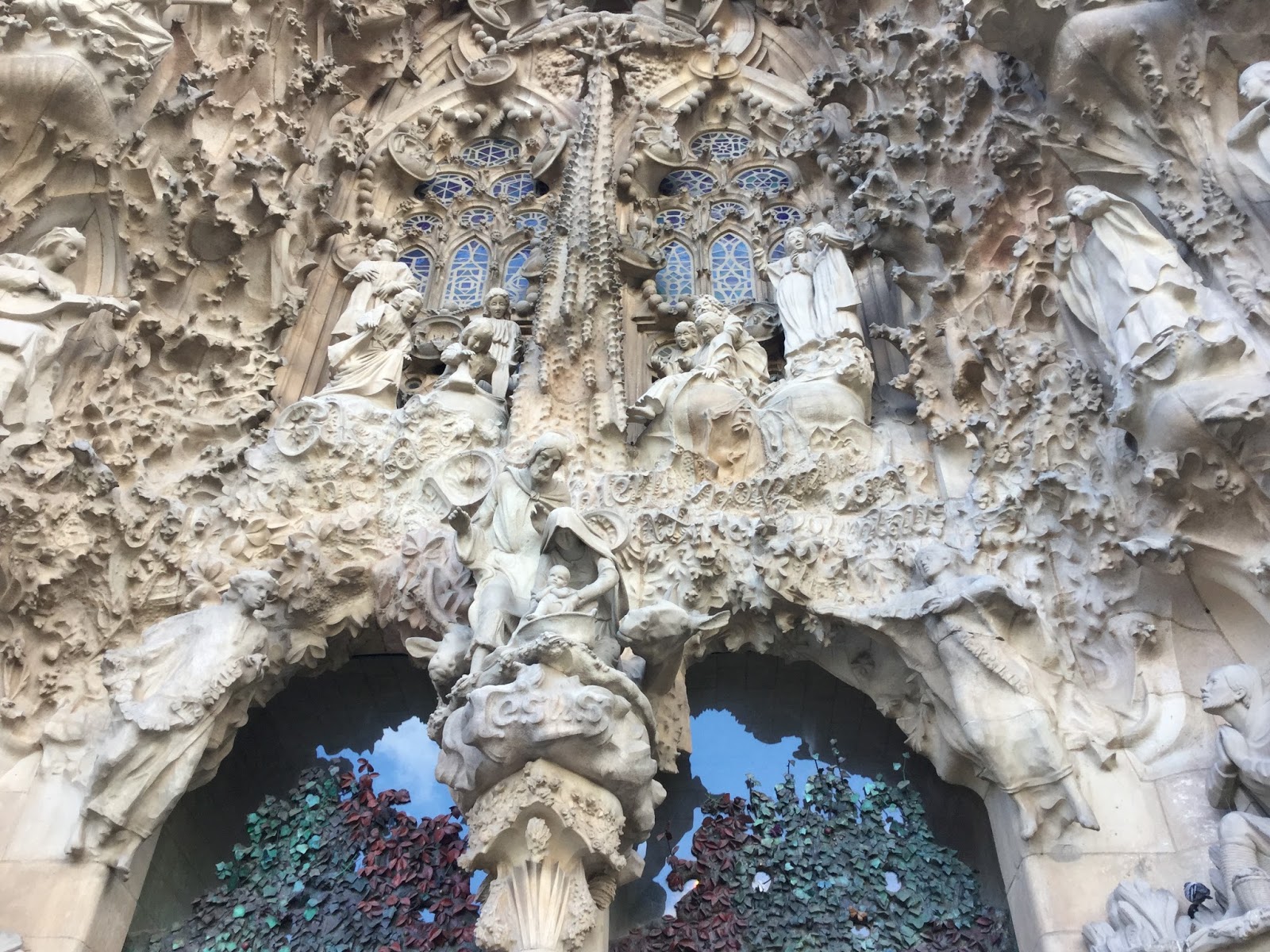
With Gaudí, everywhere you look you see amazing detail. For example, below is a photo of the statues above the entrance. The opposite side has statues in a completely different style. They are very angular. Modernist in style.

Pic of statues on front of Gaudí's Sagrada Família
Details above the entrance to Sagrada Família

As you walk around, you find yourself constantly looking up to the Heavens. Gaudí was a very religious man. He devoted the final years of his life to his expiatory church and even lived on site.

Pic looking up at the detail of the roof inside Sagrada Família
Looking up at the ceiling of the Sagrada Família's nave

My few Spanish words came in handy. Knowing how to pronounce Spanish words correctly was a big improvement on my first visit. I didn't understand the Spanish and Catalan spoken around me at speed. It's frustrating for a linguist to go back to beginner's level. I bought a children's book about Gaudí in the Park Güell shop. It is the perfect inspiration to keep going.

I hope to return to see the Sagrada Família finished one day in all the glory that Gaudí intended.


Wednesday, 15 July 2015

Deaf ears at the EU?

Icon for hard of hearing
Media Translation and Accessibility in the EU were discussed at UCL on 25th June. The presentations, documentary, videos and discussions highlighted weaknesses in the EU's current fulfilment of its accessibility obligations towards EU citizens.

The discussion arose from the research of three UCL PhD students: Silvia Kadiu, Aysun Kiran and Renata Mliczak. Their findings and report will be published later in 2015. This blog will focus on the round table at the end of the seminar.

Non-discrimination and capacity
The Demand Management Unit manages the European Commission's communication needs against Directorate General capacity. Translated web content forms an important part of the European Union's drive to bring itself closer to EU citizens. Non-discrimination is regarded as a primary factor in deciding on coverage.

EU and UN Convention
The European Union has signed and ratified the UN Convention on the Rights of Persons with Disabilities. It was stated that some 8% of Europe's population has some sort of accessibility requirement - e.g. sight impairment, hearing impairment or old-age-related. Increasing life expectancy and an ageing population are likely to increase these figures and future demand.

Article 7 of the Audiovisual Media Services Directive (AVMSD) states that:

Member States shall encourage media service providers under their jurisdiction to ensure that their services are gradually made accessible to people with a visual or hearing disability.

Text should be available in alternative formats - e.g. braille, automated subtitles, etc. Today's communication requirements are not just confined to the translation of legal reports, legislation and press articles. Today the EU has to consider video, Twitter, Facebook, etc.

Translators
During the session, one-off videos were played of in-house translators who kindly assisted the PhD students in their research at the Directorate-General for Translation. These were not official interviews on behalf of the EU, rather they reflected personal opinions. The interviews gave a revealing insight into the translators' personal experiences and opinions on the current status and approach to audiovisual translation within the EU.

The viewpoints expressed often seemed at odds with the official stance. The translators seemed to have limited audiovisual project experience during their time with DGT. They seemed to feel that DGT did not have a subtitling strategy. Such projects seemed to relate more to personal preference and audiovisual requirements were only considered at the end of the translation process. One translator rightly pointed out that European citizens do not read legal web content. They need more digestible and accessible content.

EU "Not leading by example"
After the videos, the invited panel drew out the issues. The chief concern was that the EU is "not leading by example".

Expert panel
The panel of experts included:
Dr Robert Adam, Research Associate, UCL (deaf native signer)
Dr Jorge Díaz-Cintas, Director of Centre for Translation Studies (CenTraS), UCL
Angeliki Petrits, Language Officer, European Commission Representation in the United Kingdom
Mrs Lidia Smolarek-Best, European Federation of Hard of Hearing People
Prof. Bencie Woll, Chair in Sign Language and Deaf Studies and Director of DCAL, UCL

Software issues
Dr Jorge Díaz-Cintas underlined that the European Commission's in-house Directorate-General for Translation (DGT) does not always understand all the issues. Jorge expressed particular sympathy for the translator who mentioned the difficulties of using subtitling software available within DGT. Lines are limited to 60 characters and the end-result looks ugly. There is far better freeware available for download online. However, for security reasons DGT translators are not permitted to download or install such software on their own.

Lack of drive
It was felt that there was an effort to reach out on accessibility issues, but there is a lack of drive to support such efforts from the top. Availability very much depends on the language concerned. For example, it was stated that many Greeks were unable to access information. As a result they often have to make do with US rather European audiovisual material.

Theory v. Practice
The panel stressed that there are clear descriptions on what is necessary for people with disabilities. The EU has signed up to the policy. However, there is a severe failure to understand the obligations related to this commitment. A voice-over is seen as an aesthetic choice rather than as a matter of access. The panel considered that there is a passing of responsibility. As the matter is not addressed properly at the top, those lower down the line do not have the necessary information or instructions to implement the audiovisual policy. It is seen as difficult for countries like Greece and Poland to argue for greater accessibility, if EU communications do not lead by example. By contrast, the BBC has set some standards to follow.

Web content progress
Angeliki Petrits defended the EU. She contrasted the subject of accessibility with web content from her perspective as an EU employee with 25 years' experience (no direct accessibility involvement). Angeliki stressed that ten years ago the EU did not have any web content. She considered that the EU was "100 years ahead of that now" having made a huge amount of progress.

Budget and political will
In order to address the accessibility issue, there has to be a top-down decision. There is immense pressure on resources with a 5% cut in budgets at the same time as an increase in translation volume into 24 official languages. The panel felt that the budget would be forthcoming if there was sufficient political will at the top.

Deaf MEPs and accessibility
Dr Robert Adam revealed that there are two deaf MEPs - one from Hungary and the other from Belgium. They have equality of access. The UN Convention makes reference to a sign language requirement and the two deaf MEPs have access to sign interpreters in the European Parliament Chamber.

The current situation was likened to the well-known British sitcom "Yes, Minister" with everyone working from a different hymn sheet. There needs to be equality in the treatment of spoken and sign languages.

Notable "absentees"
The panel also noted that not all Member States have agreed to the 2011 requirements. Many countries are behind Britain in its approach to accessibility. For example, I was surprised to hear that a country like the Netherlands, normally considered to be so forward-thinking, has not signed up (even more surprising given the high visibility of Dutch speakers in the European Commission's leadership today). Norway and the United States were also notable "absentees".

It was felt that the EU is not being proactive enough about accessibility. Greater efforts need to be made to automate the process. Dr Jorge Díaz-Cintas commented that in the United States they are making advances in machine translation for audiovisual translation. Only English and Spanish versions are produced there. The EU is struggling to meet requirements for a far greater number of official languages with an outdated and inadequate software.  There is a big disconnect between requirements and staff knowledge, experience and expertise with film and technology.

In conclusion, the panel stressed three points:

1. Draw attention to the legal basis for accessibility in the UN Convention
2. Strategy - Is there one? How can it be targeted to increase accessible services?
3. Positive note - 10 years ago there was no web content, today DGT is trying to make greater use of video.

The EU needs to offer a "best example" approach to accessibility and spread the word to Member States and globally.


Karen Andrews, content writer
Karen Andrews runs
Anglicity Ltd. She is
an entrepreneurial
French to English
translator, editor,
content writer and
marketing consultant. 

Contact karen@anglicity.com 
for further information 
on Anglicity's services.