Showing posts with label Twitter. Show all posts

Tuesday, 10 January 2017

Video for SMEs


Pic of handheld video digital camera complete with microphone


In late September 2015, I followed a Guardian Masterclass run by Rosenblum TV entitled Professional Video Boot Camp. The course covered how to film and edit videos using Adobe Premiere Pro. There was a lot to take in during the 4-day course. It has taken a while to experiment and consolidate my learning alongside other business tasks. This blog is about that journey and how I am now actively using videos in my marketing plans.

The Course
Firstly, note that this is not a course for the faint-hearted. Michael Rosenblum is a fierce critic. The flaws in your early filming and editing efforts will be exposed in front of the rest of the class. The good bits will be noted too and his expert and sound advice will carry you forward to your next video. It’s all done in good humour and with your best interests at heart. Just leave any ego at the door.
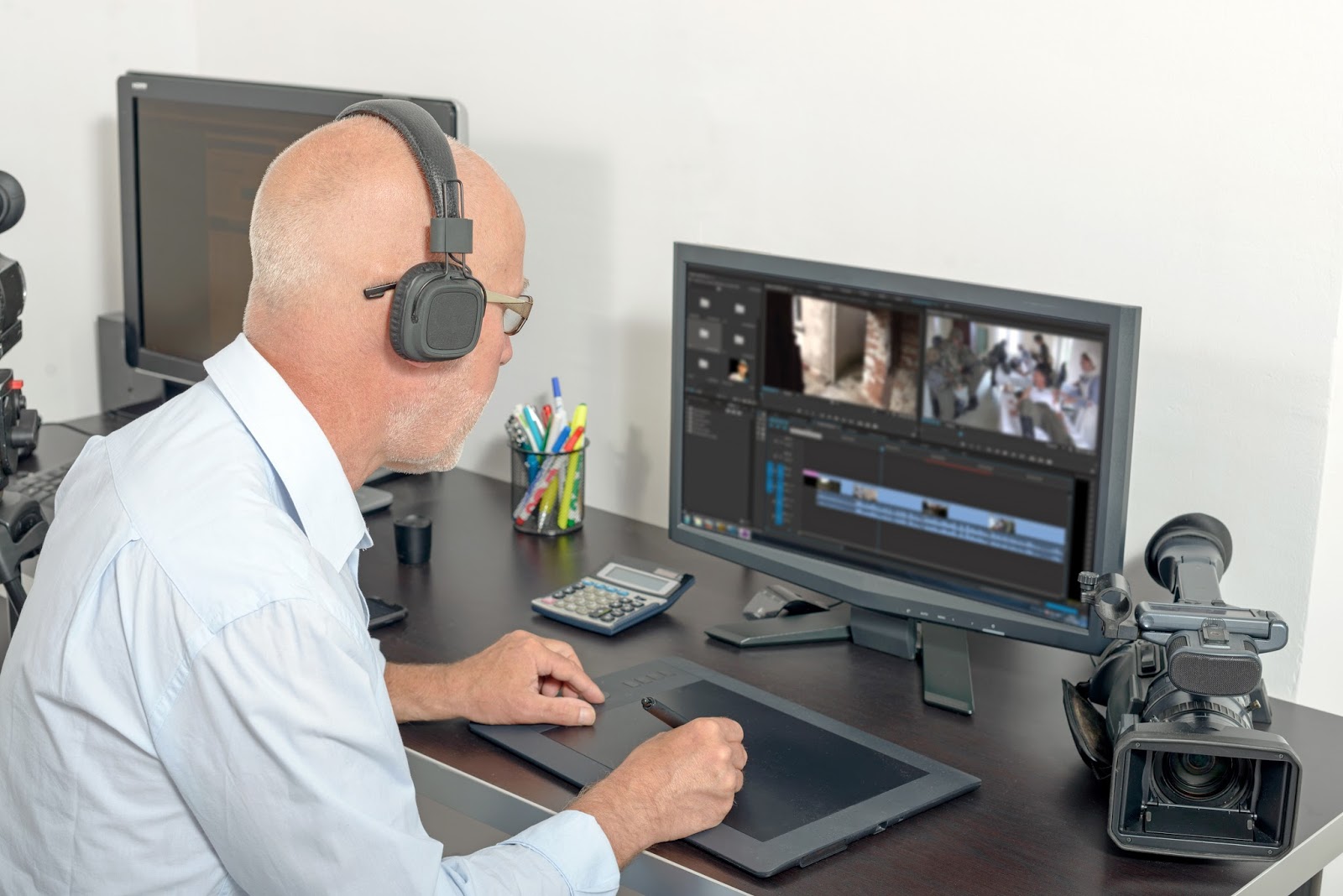
Pic of man sitting in front of video editing programme on screen and handheld camera on desk
Video editing and voice-over production with modern handheld camera on desk

First Video at the Barber's
My first effort took me to an Italian barber’s shop close to the Guardian’s HQ. The owner, assistant and customer were all obliging. I tried to follow the advised Rosenblum technique. Theory and practice are different. On my return, I edited a 3-minute video. Michael’s main criticism was that I didn’t get close enough to the action. I pleaded the presence of some very sharp scissors and bruising bumps from the hairdresser. Never mind all the tricky mirrors. Not accepted. Apparently, I should have suffered scissor cuts and bruises for my craft.


Pic of barber cutting man's hair with sharp scissors and comb reflected in mirror
Tricky filming situation: sharp scissors, moving barber and mirrors

Action Movie at the Park
My next effort took me to Regent’s Park in search of a moving action sequence. I spotted a group of 3 women walking and chatting in the park. The elderly lady was in a wheelchair, but she kindly agreed to help with my little training video. I took some great footage. My stroke of luck made it even more powerful than I could possibly have imagined. Michael was impressed.

Pic of lady in wheelchair from waist down with focus on her hand on wheel and blanket on her lap
Elderly lady in wheelchair in park

After the Course
Most of my early efforts remained in the camera. I investigated filming conditions with my local borough. The insurance requirements and other stipulations proved prohibitive for a small business. They seemed better suited to a BBC or major film company production. I was not going to arrive with several articulated trucks, a film crew or even a tripod to obstruct passers-by.

Given Michael’s advice, I avoided boring talking heads. He’s right that no-one wants to listen to 20-50 minutes of that. How do you film yourself? Ever resourceful, I ended up using a toy robot (actually my son’s pencil sharpener) to fit my storyboard idea. I stayed well clear of passers-by and the High Street. Just a modest little video for local purposes.

Format
I discovered another problem with videos. You can’t post them in the same format on different social media. They often won’t play. Twitter restricted the length and formats used. Videos catch the eye in a feed. I noted that the feed presents videos differently on my laptop, iPad and mobile. I reverted to photos as the more eye-catching method until more recently.

Generation Y (Millennials) and Z are very visual. Many of today’s marketing decision-makers are Millennials. Most translators only think in text formats to attract their attention. Millennials like to see rather than just listen.


When confronted by a listening or viewing time of 20-50 minutes, many of us will delay until later. We may not come back at all. Videos of 1-3 minutes are more likely to be viewed immediately. I took the Rosenblum course to understand the medium better. It has served me well, as I now work with an amazingly creative French design company.

Opportunistic Videos
More recently I have become more opportunistic in my own video efforts. The subject of translation bores clients, so I film cultural events. Such events are well staged and lend themselves to filming by the amateur, semi-professional and professional alike.

I currently prefer my iPad to cameras for video and photographs. The quality is always improving and people are less self-conscious about being filmed in this way.  I frame shots better and can switch between the video, slo-mo and photo settings easily.

Viewing video on tablet

Editing time is also another bonus. On New Year’s Day, my iMovie video appeared as the second YouTube video posted for the London parade. Rosenblum’s filming technique equips you to edit speedily. I now know not to drag the camera, to focus on small details to create interest and not to worry about people walking in and out of my shot.


Video on its own doesn’t always gain interest. I find that using video, animation and photos in conjunction with blogs and social media raises my business profile. They carry on working for me when I am busy translating or at other events. I have been amazed at the increased viewing figures in my blog’s analytics.

Translators concern themselves with fine details. Giving up perfectionism isn’t easy. I never envisage becoming a full-time professional video editor. It’s another skill in my marketing toolbox. It’s helped me to understand how to make words and pictures work together better.


For a truly professional video, I would call in an experienced expert – just as I would expect a video expert to call upon a professional translator for marketing translations. Social media video postings don’t have to be perfect. Their quality may not meet Rosenblum TV’s standards, but they are fit for my immediate purposes and offer better quality than Periscope. 

And video editing is a fun skill to learn.

Karen Andrews is a freelance French to English translator, transcreator, content writer and editor. She has a strong background in global marketing.

Email Karen for further information via karenanglicityen@gmail.com in French, German or English.

Sunday, 2 August 2015

From Sceptic to Digital Convert


Pic of laptop with iPad and smartphone resting on top

Reluctant hack converts to enthusiastic digital journalist would be a fitting subtitle. Jon Henley described his conversion to digital journalism in the first session of The Guardian's latest Masterclass. His experiences contain echoes and insights for the translation community and many other fields.

Jon Henley started his career as a Dutch to English translator. Like many a translator, he has seen a dramatic transformation since the old typewriter days. He shared his journey as an "ageing hack" (his words, not mine), who is now embracing the digital revolution. He outlined the opportunities in "New Ways of Storytelling".

Old days
In the past, journalists viewed themselves as "dispensers of the truth". They would decide
a) what was newsworthy
b) its degree of importance
and even
c) your opinion on the subject.

The traffic was all one-way. There was little comeback from readers. Newspapers provided "the first draft of history". Even the letters page involved careful selection and editing.

Journalism today
And now? Journalists have lost their monopoly. Jon viewed this challenge as "a good thing in retrospect". Today, anyone with a smartphone and a Twitter account can act as a journalist. The Egyptian people tell the world about unfolding events in Tahrir Square.

Pic looking down on tiny people forming shape of a video camera

Engaged readers
Jon acknowledged that some readers have always known more than journalists on a given subject. Journalists are not always accurate. Today, the general public can correct them. And they do...

Today's audience act as fact-checkers and contributors. They comment. They propose storylines. They suggest new contacts and avenues to explore.

Millions access The Guardian's website rather than the printed newspaper. They find their way via a web search or a shared link on a variety of platforms.

Readers have now also become distributors. The traffic is now "multi-million way". News flows in all directions.

"Articles are the beginning of a process, not the end".

 Andrew Sparrow's Politics Live blogs illustrated this point.

Journalists in demand
Despite the dramatic transformation, the underlying principles remain the same. In Jon's view, the old days were not necessarily the "good old days". Whereas journalists used to approach people for stories, those very same people now come in the front door actively seeking journalists out.

Stories of the Greek people
Jon contrasted the "bad old days" as a foreign correspondent in France with his more recent experience of reporting on the Greek crisis. He described French bashing after consulting with the past's limited sources against the use of Twitter to engage with ordinary Greeks for stories of hardship and self-help. He had hundreds of replies before even landing in Athens.

Responsible follow-up
Open journalism is not without its difficulties. A medical story could have threatened Greek tourism when German and British tabloids picked it up. A good follow-up story created a positive vibe and increased The Guardian's web traffic. There was even a tweeted suggestion of Greek citizenship.

                                  "Responsive and responsible journalism".

The project was conceived on the Internet from the very start. The audience really wanted to get involved. They wanted people to be properly and honestly informed about their situation. 

Jon Henley is now convinced that working in this way helps to rebuild public confidence. In the public eye, journalists have a reputation that is "not much above politicians".

Verification remains important. The response can make you dizzy. A journalist should not abandon traditional judgement and values. Reports should still be objective, accurate, balanced and complete.

Benefits of open journalism
Open journalism harvests stories and gets results faster than the old ways. It is:
a) effective
b) beneficial - building trust and engagement
c) essential in the Internet age (although not suitable for everything).

Powerful storytelling
Video is a powerful way to tell a story, as in the case of a Tasmanian family hiding from a bushfire. The Guardian's Firestorm included videos taken by those on the scene at the time. The interactive story took weeks to create.

It is hard to predict what the future will bring. Journalism has changed dramatically in just 5 years. In Jon Henley's opinion, the transformation has brought more effective and responsible reporting, a more democratic relationship with readers and terrific storytelling.


Karen Andrews, content writer
Karen Andrews runs
Anglicity Ltd. She is
an entrepreneurial
French to English
translator, editor,
content writer and
marketing consultant. 

Contact karen@anglicity.com 
for further information 
on Anglicity's services.

Wednesday, 21 January 2015

Hitting your target audience with blogging


Ten pin bowling


In this third blog on target audiences, I move on from the National Gallery documentary to my own blog. Marketing is not an exact science. There are constant adjustments. Sometimes you hit your target audience. Sometimes you miss. Sometimes you hit an unexpected target. I will share what I have learnt from my own blog targets.

Early blogs
I wrote my first blog back in 2012. I came from the conservative marketing world of financial services. The reaction to my first blog was unexpected. My perspective was still very much that of a client on translation. That first blog went "viral" on Proz.com. Success or failure?

Other early blogs drew vocal reactions. They were not generally my targets at all. Over time I have developed my style and tone. Adverse comments can make you think that you have got something seriously wrong. To the outside world, it may appear that blogging is risky. However, I have now learnt that if something feels 100% comfortable and safe, it won't have many readers.

Analytics
Checking my blog, Google+ or Twitter analytics is like looking under the bonnet of a car. I can see which subjects gain a bigger readership, on which devices and in which countries. Initially, a post receives some adverse comment perhaps. The uproar is visible. But analytics show that my blog has a much larger, quiet readership.

Blog content often seems to reach a wider audience than even analytics reveal. Other translators refer to my blogs at events. I hear my own written words quoted quietly and indirectly. Some disagree. Some agree to disagree. But many more seem to quietly agree. Translators are not my target audience, but they do sometimes give referrals.

Evolution
When I started my blog, my target audience was direct clients. My actual clients and prospects have turned out to be direct clients (private individuals, freelance translators and companies), translation, transcreation and content management agencies. Blogging hasn't brought this about in isolation. My strategy has evolved. I have tested out different content to reach my varied target audiences.

It's a bit like ten pin bowling. Some blogs end up in the gulley. Others hit the buffers and bounce back in. Sometimes you hit the outer pins only. Over-adjust and you hit the pins on the opposite side. Sometimes it takes two blogs to hit all the pins.  And then, just when you think the ball is rolling off to the side, you get a strike.


Strike


Whatever... I enjoy writing and building up a portfolio of work. It's a hit.

What are your views on blogging?


Karen Andrews, content writer
Karen Andrews runs
Anglicity Ltd. She is
an entrepreneurial
French to English
translator, editor,
content writer and
marketing consultant. 

Contact: karen@anglicity.com 
for further information 
on Anglicity's services.