Showing posts with label climate change. Show all posts

Wednesday, 5 December 2018

The New Karen Communications Consultancy Blog

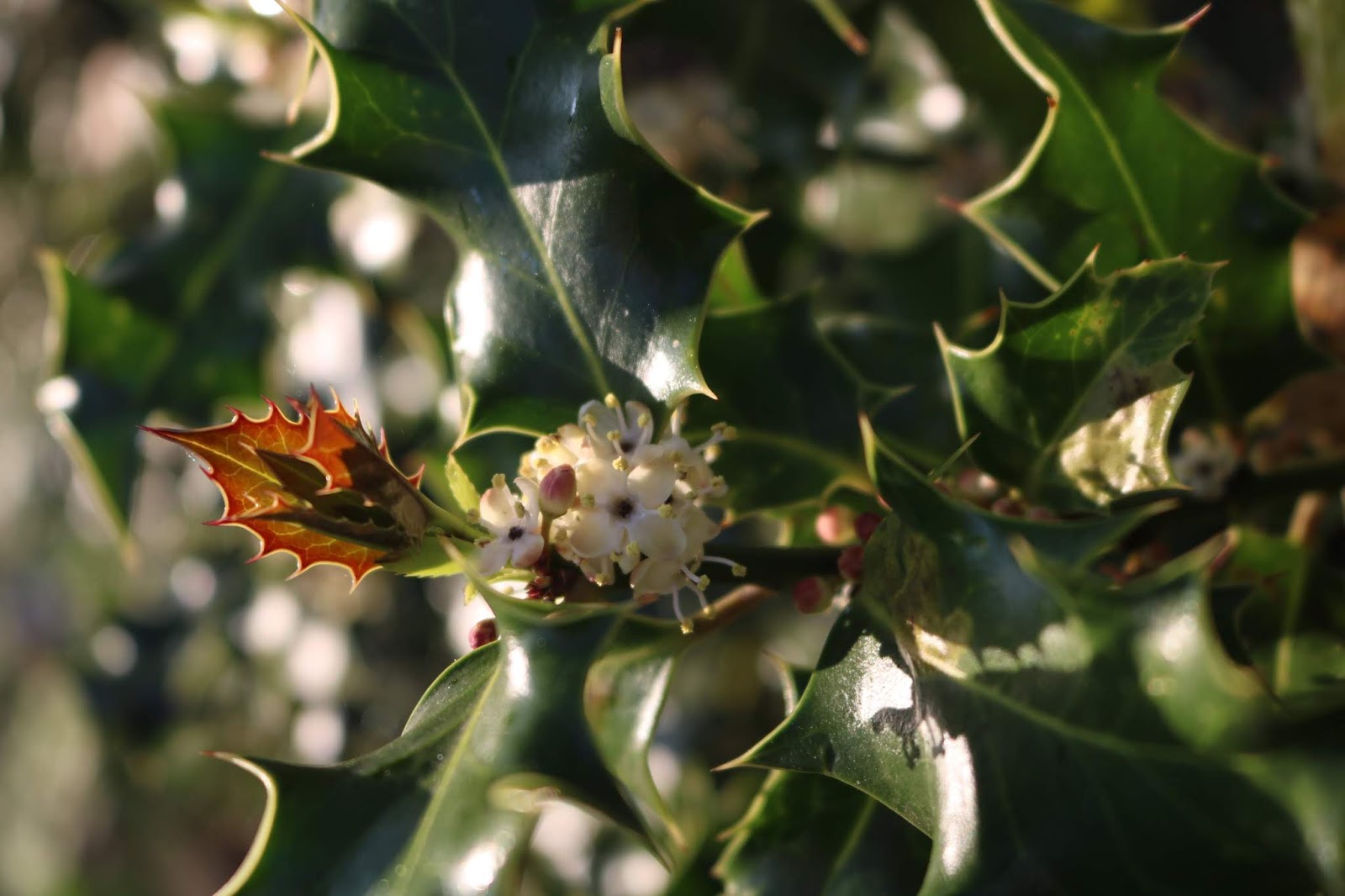
Pic of sunlight on holly flowers and prickly leaves


Karen Communications Consultancy Blog

Have you seen the blogs on my new website? The new series is beginning with Christmas blogs on a botanical theme, having recently completed my MSc in Plant Diversity. The plants have been deliberately chosen to show the diversity of the world's plants rather than merely repeat the standard range of Advent plant choices.

As well as showcasing the beauty of plants, my content strategy also highlights some of the serious topics on plants this Christmas. For example, climate change and plant blindness are very much to the fore this December.

Link to the blog with details of some of the individual content below:
https://karencommunicationsconsultancy.wordpress.com 

2018 Botanical Advent Blogs

Links to the first five posts on my new blog and venture for Karen Communications Consultancy are below:

Holly for all Seasons

Common or European Holly, Ilex aquifolium

Holly often only gets noticed at Christmas.
Gardeners and missing berries.
Holly works hard all year supporting local biodiversity.

Rehabilitating a Rotten Fruit

Common Medlar, Mespilus germanica

A unique fruit that is eaten 'rotten'.
Winter fruit valued in past, now out of fashion.
Does it have local potential due to climate change?
Shakespearean tale of mistaken identity, origin and unexpected new sibling.


Mahonia for Winter Sunshine

Oregon Grape, Mahonia aquifolium and other Mahonia species

Botanical classification, winter colour and fruits.
Value as a medicinal plant in both Chinese and Western medicine.
A Christmas Aspen Tale

(European) Aspen, Populus tremula

British folklore and botanical details on the quivering Aspen.
Native species as opposed to the North American Aspen, Populus tremuloides.
Fragrant Winter Daphne 

Daphne genus with a particular focus on Daphne bholua.
Valued for its fragrance and beautiful winter colour range.
Protected medicinal and poisonous plant.
Discussion of climate response, plant blindness, labelling, etc.


The new website is still in development. Feedback is welcome on what works and what needs improvement. What features do you like? What information or services would you like to see?

In the meantime, enjoy the approach to the Festive Season.

Best wishes for the end of 2018 and a great 2019.
Karen


NB:
Clarifying my Surname
I prefer to just be called Karen by everyone. I tend to write in my maiden name of Andrews. Netto remains my legal name. My apologies if this causes digital confusion. I am one and the same person. I've put both surnames together for the time being on the new blog.

There's an Australian MP who shares my first name and maiden name and it's hard to compete digitally with her. Netto seems to send everyone to the wrong country and language combination. It's a Portuguese or Brazilian Portuguese name in origin, but most French speakers think it makes me Italian. I am 100% British with a lot of Welsh and English ancestry, some Scottish ancestry and one great-grandmother who was born in Jersey.

I'm pleased to be one of that rare British species who loves other countries' languages. I speak, write and translate French. I also have varying fluency levels and understanding of German, Italian and Spanish.


Thursday, 30 June 2016

Brexit Battles Ahead

Middle-aged man with glasses, eyes shut and fingers in ears

Brexit has gone over the top. Ironically, today is the centenary of the Battle of the Somme.  It achieved nothing. It robbed both sides of a generation.

History teaches us that the seeds of the Second World War were sown in the negotiations at the end of the First World War. The desire to punish creates new grievances. Nasty Brexit negotiations will sow such seeds.

Where is home?
Brexit’s uncertainty has all the makings of a new war. There has already been a marked increase in hate crime. It’s already too late for a genuine Brexit. There are children here from many European nations who know only Britain as their home. They can’t go home – they are at home. Vulnerable British expat pensioners are now more at home in Spain and Cyprus.

Hungarian children at a London event
Scare stories
Brexit could turn into a bitter civil war. We have already seen how irresponsible political campaigning may have caused two young children to lose their mother. As the lawyers on both sides play hard ball with each other, the Media will report scare stories. Those affected by the conflict will not be arranged in trenches on opposite sides. They will be living intermingled with the ‘enemy’. It’s a powder keg that can only lead to tears.

Economy
It is ridiculous that the pound collapsed based on the Brexit announcement. Britain had triple a AAA rating. France has risen in the economic ranks without lifting a finger. We haven’t even left. It’s not clear if we can extract ourselves constitutionally. The financial markets are crazy. They make money and cause human suffering from such madness.

Science and Climate Change
The best European scientists should be working together on climate change solutions. Brexit could prove a costly distraction. Rumours already suggest that it might not be a good idea to apply for EU grants with British universities, even though there are two more years to run until Brexit. Fear and uncertainty is enough to create this new approach. So where will scientists go? Will all their expertise head for Germany and create further economic and industrial imbalance in Europe?

Brexit Issues
There is an elephant in the room. No-one likes to mention it. How do you ask the question and answer it tactfully? Why did elderly Brits vote for Brexit?

Yes, immigration was a major issue. Ordinary people are the ones who feel the consequences in hospitals, GP surgeries, housing shortages, etc. They are still suffering the consequences of the financial crisis – worrying about job security and pensions.

Despite all the issues, the older generation particularly stress that they don’t like to be told what to do by Europe. My parents’ generation were children during the Second World War and its aftermath. Their generation is very conscious of the sacrifices made by earlier generations. They respect the great debt that can never be repaid. Today Germany is again the strongest nation in Europe. Can you honestly blame them for feeling uneasy? They are keeping a watchful eye out for their grandchildren – those same grandchildren who are currently angry with them for destroying their European future. Which generation is right? There are probably elements of truth in both viewpoints as ever.

German supremacy was highlighted when I visited the European Parliament earlier this year. Voting is based on population numbers. Turkey is closely allied with Germany and will have a high number of votes on entry. The balance is wrong and needs adjustment. Smaller nations are complaining. The German President of the European Parliament wants to stay on again beyond his agreed time. If he were of any other nationality maybe this would not be such an issue. Perhaps the German people can tell him to go? No German that I have ever met wants to create an atmosphere of fear - or even an inkling of one.

Farcical Politics
British politics currently resembles a farce. It is a blend of Belgian and German politics. Resignations all over the place. The United Kingdom’s constitutional issues are so entangled that it may take 2 years to find a way through. We are more a part of Europe than the ordinary Brit realised. It’s not possible to extricate ourselves without enormous social and economic pain for all member states.

The UK's piece of the European Puzzle ©Octavus


Timely, Flexible Thinking
When I visited Berlin in 2014, Germans told me about their labour market. They recounted how difficult it is in Germany to change your profession. The future job market demands greater adaptability. At this time Europe requires less rigid, more out-of-the box thinking from its policy-makers. The ethical and social challenges of technological developments are coming fast and furious. We need timely, flexible thinking and access to the best brains in all fields.

As an experienced project manager, I know that no project ever runs directly to the plan. You have to adjust your thinking mid-project to reach a successful conclusion. Sometimes you have to rewrite the rulebook because the old one is more of a hindrance than a help.

Nation of Debunkers
I recognise that my wonderful, brave, independent island is a repeated thorn in European sides. Britain regularly provides the perfect foil to rigid German thinking and French idealism. We provide counterbalance. As David Cameron said we are a nation of debunkers. If something is not working, we will not pretend that it is, as other friendly nations may. We are a pragmatic race. For us, Europe must work and be seen to be working.

Dear EU, sometimes it is your best friend who tells you the truth you do not want to hear. Please take your fingers out of your ears.


Wednesday, 10 February 2016

Prisoners of Geography

pic of book on top of EU map


Travelling provides an excellent opportunity to catch up on some reading. Tim Marshall’s Prisoners of Geography provided absorbing material for my recent Eurostar trip to Brussels.

Brexit seemed to be on the minds and tongues of everyone I met in Brussels – from the European Parliament to the EU Studies Fair, as well as on all newsstands and points in between. Questions and what ifs abounded. It was interesting to hear and read views on our island nation from outside our borders.

Britain has been blessed by its geography unlike many countries described in Tim Marshall’s book. It has been our fortune to be

“close enough to the European Continent to trade
and yet protected by dint of being an island race” (p91).

Our geography has shaped our independent spirit. We are also seen as being

“at one remove from living with the historical collective memory
of frequent invasions and border change” (p91).

Thanks to our geography we have grown accustomed to punching above our size and weight globally. As the sole Brit, I was outnumbered by youthful representatives from the other 27 member states on the European Parliament tour. There were also young visitors from candidate countries.

I couldn’t help wondering how Britain’s future generations would feel about being outside the “club” whatever its faults. The Union Jack seemed to be on the way out already. Then, I realised that its position at the end of the line was probably due to the diplomatic use of alphabetical order.


Pic of European Union flags in a line inside the reception of European Parliament, Brussels


Our excellent Latvian guide was very open in discussing both the good and bad aspects of the European Parliament. He mentioned the financial wastefulness of the Strasbourg Parliament. (It is still maintained due to the ongoing vetoes of France and Luxembourg). He shared the difficulties of progressing any legislation without Germany’s support. He mentioned the frustrations of smaller nations and parties in getting their voices truly heard.

Pic of the European Parliament's debating chamber in Brussels


Human rights were seen as a strong area for the EU. For example, the EU can criticise China’s human rights’ record and invite the Dalai Lama to speak to the Parliament without fear of trade reprisals. The 2015 Sakharov Prize for Freedom of Thought went to the Saudi Arabian blogger, Raif Badawi. Europe enjoys peace and freedom of expression under the EU’s watchful eye.

Prisoners of Geography is particularly strong in explaining how geography shapes Russia and China. It invites the reader to picture Putin ruing the absence of mountains and watching as the EU encroaches ever closer through the former Soviet bloc. Ukraine was “the red line”. As Tim Marshall concludes:

“It doesn’t matter if the ideology of those in control is tsarist,
Communist or crony capitalist – the ports still freeze,
and the North European Plain is still flat” (p25).

The world’s flashpoints are all enlightened with reference to their geography. The Arctic features at the end of the book. The melting ice cap is changing geography. Climate change is creating new tensions. 80% of Bangladesh is on a flood plain and it cannot relocate. The Maldives will disappear.

In conclusion, the author casts our eyes upwards away from the land. He refers to spy satellites and international cooperation in space. He speculates whether we will learn to meet the challenges ahead as “representatives of humanity” rather than as of a particular nationality. The road ahead seems to require even greater cooperation, rather than a self-interested retreat within our own borders.

Tim Marshall ends on a pessimistic note:

“... we are still imprisoned in our own minds,
confined by our suspicion of the ‘other’,
and thus our primal competition for resources.
There is a long way to go. (p240).”

I hope history will prove that he should have been more optimistic. It is an eye-opener to discover how much world tension is based on geography rather than our neighbours’ actual actions.

Book review details:
Tim Marshall: Prisoners of Geography. Ten maps that tell you everything you need to know about global politics. Published by Elliott & Thompson, 2015.


Saturday, 9 January 2016

Ice and the Sky Review


The cinema was as desolate as the Antarctic wastes in the film. Apparently, London’s expat French community had already headed home for Christmas. I had come to see the Luc Jacquet’s stunning Ice and the Sky at the French Institute’s Ciné Lumière. The quiet cinema only served to heighten my appreciation of the often lonely figure of Claude Lorius on screen.

COP21 release
This film was released to coincide with COP21, the 2015 United Nations Conference on Climate Change in Paris. The French glaciologist, Claude Lorius spent over 10 years of his life in extreme conditions. He went on 22 polar expeditions between 1957 and 1985.


The film's French name is La Glace et le Ciel 


Lorius at all ages
Ice and Sky tells the story of his life and groundbreaking climate research. It combines old film footage with beautiful shots of Antarctica. We see Claude Lorius as an enthusiastic young adventurer. We see teams of scientists drilling into the ice and carefully packing the ice samples for later analysis. We see staged shots of the reflective old man, now aged 82/3.

Eureka
A scientist’s eureka moment is often mundane. An apple fell on Newton’s head. Hawking got his head stuck in a jumper. For Lorius, it was a piece of Antarctic ice dropped into a glass of whiskey. He realised that the air bubbles released might tell a tale. 

Evidence
So it proved. There was evidence of the atomic bombs dropped on Hiroshima and Nagasaki. Evidence of man’s adverse effect on the planet could even be found in Antarctica’s virgin territory. He went on to sound the alarm on global warming and expose Man’s devastating impact on the world’s climate.

Painstaking accuracy
We hear of the scientist’s concern to record his findings accurately even in the bitterest cold. Removing your gloves to write is a painful experience in Antarctica.

Bitter pill
The old man on screen seemed sad and forlorn. His life’s work has been climatic in more ways than one. He has won prestigious awards for his research. And yet, the call for climate action has been hard. Awards become a bitter pill, if your research is not taken seriously.

Lost voice
In the film, he has no voice. His words are narrated or captured in old footage. A voice taken away as his findings were denied for so many years.

Critics
Film critics have slated Jacquet’s shot of Lorius up to his knees in water as manipulative. People only really understand research implications when they are presented visually. I’m sure those who had to wade through flood waters in Britain this Christmas get the picture.


Pic of bench surrounded by flood waters


Retrospective
At the end of 2014, I wrote my ambitious hopes for the world in Climate Change: seeking an impossible solution.  I also wrote about the Paris launch in COP21 World's Last Chance. My impression is that the UN climate talks delivered an agreement that was better than anticipated at this time last year.

Beauty and thought
Ice and Sky is a thought-provoking film. It has certainly provoked my thinking. Its cinematography was perhaps too beautifully French for its serious global message.

Epilogue?
The film deserves an epilogue. We should hear from Claude Lorius on camera, and in his own voice, how he feels about his life’s work following COP21 – and hopefully see him smile.


Thursday, 10 September 2015

COP21: World's Last Chance


Pic of two hands with world map painted on them

"We are counting on you!" so said the children in a video clip shown at the Élysée Palace. France staged its COP21 launch in Paris today. The 2015 United Nations Climate Change Conference will take place in Paris from 30 November to 11 December. The COP21 conference is the world's last chance to save the planet.

There was no mincing of words in Paris this morning. No more disputing whether climate change is happening. No more quibbling over how many degrees are necessary to stabilise the planet.

The world must act.

180 nations must commit and act cooperatively together. No more "we'll start next year". "Later" will be too late. Failure cannot be on the COP21 agenda.

COP21 is not about saving pretty little butterflies. It is not about saving cute animals. It is about saving mankind.

Our children will hate us for failure. Our descendants would hate us for all eternity... except if COP21 fails they won't be around to hate us.

The key to success at COP21 is telling the truth about climate change. The refugee crisis has given us a mere taster of the human agony of mass migration.

Climate change will hit the weakest nations the hardest... those with the weakest voice at the negotiating table. It calls on the more powerful nations to be magnanimous. The key word of COP21 must be "solidarity".

Short-term, blinkered, self-interested deals will ultimately rebound. They will condemn us all to share the same dire fate.

All eyes will be on Paris for two weeks in this massive conference at Le Bourget. The French are keen to set the world an example. The conference itself is to be a massive exercise in sustainability. All participants will be invited to use public transport to keep the conference's carbon footprint as low as possible. French gastronomy will be on offer with a keen eye on reducing food waste.

Anne Hidalgo, the Mayor of Paris, will host 1,000 world mayors. They will seek not only to share local ideas but ways to act together. Their plans and actions should help us to understand what this global conference will mean for us on a more local level.

The most striking comment quoted at the launch came from a Moroccan woman: 

"You are going to decide who will live or die..."


If world leaders take short-cuts for short-term popularity at COP21, the consequences will be enormous. They should bear in mind that they will effectively be signing a greater number of death warrants. Every now and again, they should check their consciences by looking at the young conference helpers around them.

There are tough choices ahead - choices many ordinary citizens couldn't bear to contemplate. We have to place our trust in our leaders to become the statesmen demanded by our planet's crisis.

We'll be watching and counting on them.


Sunday, 26 July 2015

Red light for innovation challenges?


Traffic light showing red and raised hand for stop

Walking and waving a red flag in front of a moving car? Preposterous! Yet, the US and the UK had just such a law as a safety precaution in the 19th century.

Driverless cars, drones, unmanned aircraft, space rockets, satellites and probes to Pluto... What on earth would our ancestors think? Technology is moving at a faster pace than the majority of us can take in. Should we rein in our modern day innovators, pioneers and explorers with red and amber flags while we catch up?

Driverless cars
Google reported that its driverless cars keep having accidents. The June 2015 report stated: "Not once was the self-driving car the cause of the accident". Inattentive humans are the problem.

Is the obvious fix to ban all human drivers from the road in future? It's not that simple.

Car hacking
A current Wired article is entitled Hackers remotely kill a jeep on the highway - with me in it. In a test, hackers toyed remotely with the air-conditioning, radio, windscreen wipers and then the accelerator at 70 mph...  Off the road and into a ditch... The manufacturer has issued a recall to prevent the vehicles from being controlled remotely. Recalls don't come cheap.

Accidents on land can be contained. What of the skies?

Drones
There is alarm about drone safety - particularly the unregulated use of hobby drones. In late January, Le Monde reported that drones had flown over 17 French nuclear power stations since October 2014. 

After the Fukushima nuclear accident in 2011, the world is understandably uneasy. A major earthquake followed by a 15-metre tsunami disabled the power supply and cooling of three Fukushima Daiichi reactors. An unpredictable sequence of events?

Unmanned aircraft
Unmanned craft already fly the skies on spying missions. NASA's unmanned Global Hawk can remain aloft for up to 30 hours at high altitudes. It is being used for atmospheric analysis, but was originally developed for military use. 


Challenger
NASA employs some of the world's most brilliant scientists. They've known both glorious successes and heart-breaking disasters. The Challenger Space Shuttle accident cost 7 lives.  Just 0.678 seconds after lift-off, there was a strong puff of grey smoke. The two cameras that should have reported the precise location were inoperative. A rapid series of events from 72.20 seconds followed. Challenger exploded after 73.137 seconds.

The Presidential Commission's report on the Space Shuttle disaster is full of technical detail. The accident was due to faulty design. A faulty pressure seal caused a major setback in space exploration. In the NASA control room, they knew the astronauts. They knew their voices.

Rockets explode. Satellites and probes malfunction. Space is filling up with junk.

3D printing
Technology is developing at such a pace that it is hard to predict all the challenges in advance.  Some are overstated. When 3D printing came to the fore, people worried that it would be used to make guns.

Today, most geeks content themselves with posting pictures of epic failures or cereal-box-style Star Wars characters online. 3D technology is saving lives in the medical field today.

Hacking inevitable?
Experts treat hacking as inevitable. They seek to minimise risk. Total prevention is not viewed as realistic. The "good guys" play catch up with the "bad guys". Hacking pays well.

Red and amber flags?
Modern technology is exciting. The pace is so fast. There is little time to question if technology is always being used in the best interests of Man. History should teach us caution. Do we need to slow down a bit and take stock? Issue some red and amber flags?

Shared planet
If only the best minds could work on climate change for all Earth's residents. We never get on well with all our neighbours. We just have to find a way to coexist.

Relocation isn't an option. NASA hasn't found another habitable planet for us.

Karen Andrews, content writer
Karen Andrews runs
Anglicity Ltd. She is
an entrepreneurial
French to English
translator, editor,
content writer and
marketing consultant. 

Contact karen@anglicity.com 
for further information 
on Anglicity's services.
 

Thursday, 2 April 2015

Spring Air in Paris


Pic of the Paris Flower Market in Place Louis Lépine
Spring colour in the Marché aux Fleurs, Place Louis Lépine

The third day of my recent Paris trip was officially the first day of Spring. The Marché aux Fleurs (Flower Market) in Place Louis Lépine was filled with spring colour and greenery. Paris will be hosting COP21 in the battle against climate change in 2015. Air quality was poor during my stay. French TV claimed it was worse than Shanghai.


On my first morning, the Eiffel Tower was obscured by mist and murk. At the weekend, travelling by Metro was free to encourage Parisians to use public transport instead of their cars.

Paris owes much to Baron Haussmann for its wide, "airy" streets. British cities simply cannot replicate his urban planning . Today, such an autocratic approach will not be tolerated. British cities also have much heritage to preserve and cannot emulate Paris despite inner-city congestion problems.

Boulevard Haussmann in Paris

The Recession seems to have left Paris with a backlog of maintenance repairs, but the solid infrastructure must leave many cities envious. Wherever I went, traffic seemed to move without too much difficulty - even during the rush hour. Accustomed to London congestion, I kept allowing too much time to get from A to B.  I couldn't help wondering if the wide streets were such a blessing if they made Parisians more inclined to drive into the capital.

I was very surprised by reports on French TV. Despite regulation, the French still smoke heavily in public places - and, French women are more likely to continue smoking in pregnancy. I have always understood the French to be very health-conscious.

I saw evidence of eco-friendly initiatives. Paris has its equivalent of London's "Boris bikes". I saw row upon row of them - all largely unused. Maybe because of the high pollution rates during my stay? I also saw electric cars being charged in the streets. Again, I was disappointed not to see one in use. 

Pic of electric car recharging in Paris street
Autolib' electric car sharing scheme in Paris

At the Centre Georges Pompidou, I saw an artwork by the British-born and New Zealand-based David Trubridge. It was an orange sphere representing the sun with white wings to either side. Trubridge used natural, sustainable and recyclable materials.

The work hangs above visitors' heads as a poetic reminder of the dangers of climate change. David Trubridge was inspired by both Maori legend and Greek myth. Like Icarus, Man is flying too close to the Sun. It seems an appropriate warning in the host city for COP21 - especially just after the solar eclipse.


If you would appreciate help with your technical marketing communications, email karen@anglicity.com or call Karen on +44 (0)20 8581 9369.

Karen Andrews runs
Anglicity Ltd. She is a
technical writer and 
translator with over
15 years' marketing
experience. Anglicity offers
marketing consultancy and
content marketing with a 
particular focus on innovation
and the environment.


Wednesday, 31 December 2014

Climate change: seeking an impossible solution?


2015 fireworks for a new start

As the old year draws to a close and a new one fast approaches, it is a good time for reflection on the past and hopes for the future. Elections and climate change discussions will feature strongly in 2015.

In November 2013, I attended an event at the British Library aimed at inspiring new entrepreneurs. My lasting takeaway was that even the most tumultuous start can lead to spectacular success. Lord Young emphasised the attraction of being in charge of your own destiny. Today, he appears in the New Year's Honours' list for his 50 year contribution to British public life. Margaret Thatcher famously said of him that "other people bring me problems; David brings me solutions". Solutions are just what every client wants to their business problems. Translators and interpreters are often key players in working towards such solutions.

There is a tendency in the world to think that we cannot change things. The advantage of getting older is that you can remember any number of times in the past when people said something couldn’t, shouldn’t, wouldn’t ever be changed… when the world seemed on the brink of disaster … and then something or someone budged.  The collapse of the Berlin Wall was just such an example... and yet we celebrated its 25th anniversary this year.

Eastside Gallery Berlin, 2014


Let me share my somewhat ambitious wishes for change in 2015:

1. Greater world peace has to be high on the 2015 agenda. (I am no Miss World). I would like greater harmony to be won with recognition for the value and role of professional translators and interpreters.

2. As a mother with an interest in the world after I am long gone, I would like to see a little less focus from our politicians on short-term economic gains and the next elections. We need some true statesmen and stateswomen with more selfless ambitions and greater solutions in the run-up to the UN's climate talks in Paris at COP21

To quote Nelson Mandela: It always seems impossible until it is done.


© Romolo Tavani - Fotolia.com


Let's believe we can change our planet's destiny and come up with the long-term solutions.


Karen Andrews runs
Anglicity Ltd. She is an
entrepreneurial French
to English translator,
content writer,
marketer and Mum.
Her home city of
Bristol will be
inspiring change
as 2015's
European Green Capital.
Contact: karen@anglicity.com


What are your wishes and resolutions for the world 2015?