Showing posts with label tree. Show all posts

Monday, 24 September 2018

Photo Blog: Eastcote House and Gardens


Eastcote House and Gardens in Hillingdon has undergone a major transformation since my last visit. Given the recent heavy winds and rains, the volunteers did an excellent job of putting on a such a tidy display of late summer colour and topiary.

Eastcote House Walled Garden looking towards the Dovecote

Sideways view of the planting in the walled gardenPic looking up a central path in the walled garden


I savoured the garden from every angle, before making my way towards the wilder parts of the gardens towards Long Meadow and the River Pinn.


River Pinn

There are some magnificent old trees in Long Meadow. I paused under the magnificent, sunlit canopy of the old Oak Tree below.

 Pic looking up at oak tree trunk, branches and sunlit leaves from underneath

I returned to the house where old cars were on display for the Open House London weekend.

Old car with Union Jack with Eastcote House behind
Old car with Eastcote House in the background

Pic of red vintage car and cyclist in background
One of the vintage cars in Eastcote Gardens

A quiet bench beckoned as I realised that I had missed the next 282 bus home.


 A chance to enjoy the last of the dappled September sunshine under the gardens' trees.


 Eastcote House and Gardens is open daily.


Sunday, 5 March 2017

Early Spring at Wakehurst Place (+video)

Close-up pic of snowdrops and carpet of cyclamen from ground level


Man has had a close relationship with Nature throughout time. The passage from winter into spring has always been a special time. It is commemorated in spring festivals throughout the world. The first rays of spring sunshine and flowers bring smiles to faces even in dense cities. 

I was lucky to spend a bright sunny day at Wakehurst Place recently. Wakehurst Place is home to Kew's Millennium Seed Bank. Its conservation work and scientific research should help to ensure that Man's special connection to Nature continues for centuries to come. (The Vimeo video of my walk appears at the end of this blog).

Pic of huge sycamore seeds with carpet of cyclamen behind in spring sunshine


A huge seed artwork greets you at the entrance to Wakehurst Place. Kew's Millennium Seed Bank is a world leader in plant conservation. It aims to bank 25% of the world's seeds by 2020. 


Displays inside the Millennium Seed Bank

I discovered some interesting videos, displays and figures about this important conservation work inside the building. As of 1st February 2017, the seed bank's staff have banked a total of:

  • 2,200,964,170 seeds
  • From 81,533 seed collections
  • Representing 37,614 different species
  • From 189 different countries
A Global Undertaking
Contractors were working on an extension to the vault space underneath the Millennium Seed Bank on the day of my visit. This extension will provide sufficient storage space for collections beyond 2020. There were students from Imperial College London and BSix College, as well as colleagues from Denmark, New Zealand, Belgium and Germany.

Staff and volunteers were working on cleaning seed collections from Azerbaijan during my visit. You could see into the labs through the glass viewing panes. The Millennium Seed Bank is truly an international effort.


9 grouped pictures of different seed pictures enlarged under microscope
Seeds come in all shapes, colours and sizes


Storage Process
I read a lot about how staff ensure optimum storage conditions for the seeds. Seeds are dried to reduce their moisture content and slow biological processes. The technique helps to avoid deterioration in storage at very low temperatures. Some seeds can last for hundreds of years if stored in this way. 

Staff have to be very careful when working in the vaults. They have to work quickly and wear protective suits. -20°C with a wind chill of around -27°C may be good for seed storage, but these are not good temperatures for human survival.


Pic of 4 staff wearing blue protective suits inside the freezing seed vaults
Staff wear protective suits inside the freezing seed vaults

Troublesome Seeds

The Seed Bank's research into how to store recalcitrant seeds is particularly interesting. Some species die if their moisture content drops below 40%. Coffee and avocado are two of the troublesome plants.


Recalcitrant Cocoa (left); a range of orthodox seeds (right)

The Great Green Wall
The Millennium Seed Bank is also sharing its expertise in seed collecting and the best propagation techniques with the world. The Great Green Wall initiatives in the Sahel and Sahara are helping to stabilise grass and tree roots to combat desertification. There are also pilot projects in other parts of Africa. The ambitious plan is to create a great green wall of plants and trees spreading across 13 countries.

Pressed Flowers

Pressed poppies on display
Seeing some pressed poppies brought back memories for me. If I had not taken up languages, life as a botanist would probably have been my alternative career choice. I often pressed flowers between the pages of my heaviest books and hid them under my bed as a child. A botanical version of Gerald Durrell perhaps?

My interest probably started with making daisy chains on my grandmother's lawn. My fascination with plants really took off after a cliff-walking holiday in Guernsey. The wild flowers were glorious there. 

My parents bought me a Collins Guide to Wild Flowers. I identified an amazing range of common and rare species in the local woods, hills and fields. I was lucky to live in an Area of Outstanding Natural Beauty in Somerset. I never did discover the rare Cheddar Pink (Dianthus gratianopolitanus). It only grows on the limestone rocks in a few places in the Mendip Hills and Cheddar Gorge.

Woodland Walk
After my tour of the Millennium Seed Bank's displays and different plant beds outside, I set off on a walk around Wakehurst Place's grounds. I followed a trail through Bethlehem Wood with some amazing exposed tree roots.


Pic of path through Bethlehem Wood with exposed tree roots on right bank
Walk through Bethlehem Wood

I discovered some black sheep in a field by Horsebridge Wood. I continued onward past some huge 'mushrooms' among Californian Redwoods until I was greeted at Westwood Lake by some noisy ducks.


Pic of three large mushroomed-shaped artworks in the woods


Hillside full of spring crocuses

My favourite section of the walk was near the pond. You see the brightly-coloured winter stems of dogwoods and box leading to a hillside carpet of snowdrops and crocusesIt was a very tranquil spot with the sound of the running stream and occasional bird song.


I discovered a verse of New England poetry at the top of the hill:

Give fools their gold, and knaves their power;
Let fortune's bubbles rise and fall;
Who sows a field, or trains a flower,
Or plants a tree, is more than all.


The perfect verse for a wonderful spring day. A very fitting poem for Wakehurst Place as it takes great pains to ensure that the world's seeds will be passed on to future generations. 

Below you will find a Vimeo video of my walk through Wakehurst Place:


Spring 2017 Visit to Wakehurst Place from Karen Andrews on Vimeo.


Karen Andrews is a freelance French to English translator, transcreator, content writer and editor. She has a strong background in global marketing.

Email Karen for further information via karenanglicityen@gmail.com in French, German or English.

Tuesday, 21 February 2017

Struck by Honey Fungus?


Pic of words toxic with skull as the O


Armillaria is fatal. It attacks the roots. By the time the danger is spotted, you’re a goner. Honey Fungus (Armillaria) attacks trees not the translation industry. It nonetheless provides an interesting metaphor for the current state of the translation ‘family’ tree.

If you are bathed in sunshine in the topmost branches, it’s easy to overlook or play down the creeping fungus. A well-known proverb states:

‘A fish rots from the head down’.

When an organisation fails, it is the leadership that is the root cause. By contrast, a tree rots from the bottom up. When the root system fails, the top of the tree comes crashing down too.

Pollution is reportedly bad in London. There is a fight for oxygen in the upper branches. It is no doubt a relief to see that competitive Lionbridge branch take a pruning.

Pic of long shears pruning a tree against blue sky


While your eyes are focused on the competitive branches, the honey fungus takes hold below. No problem, you think? You’ve taken measures to ensure a good flow of nutrients; the direct flow of the best university students is secure for your future growth. I’m all right, Jack*.

Future represented by conkers

Those down at the roots are much more aware of how toxic the environment is becoming than those in the uppermost tree branches.

Every now and again, those in the topmost branches have a ‘little chat’ with the established freelancers below. Those below naturally want a good rapport with those above. They need the light from above. Even if deep down they are more than a little worried about the impending storm above and the creeping fungus below, they want to sound positive and smile sweetly.

Established freelancers are the trunk of the tree. It’s a good, solid place to hang on. Honey fungus is merciless. It cracks and bleeds the bark from the base. As the summer temperatures rise, upper parts of the tree die too. The leaves look smaller, paler and less healthy than in the past. Branches die back over several years. The root system fails, just like the feared toxic environment for today's freelancers and future generations of linguists.

Pic of solitary horse chestnut, leaves turning yellow
Horse Chestnut tree with leaves turning yellow

Until recently my mother’s house looked out on a magnificent horse chestnut tree. Now, there is a gaping hole in the view and a rotting stump. The local children used to love collecting the conkers as they waited for the local school bus in the autumn.
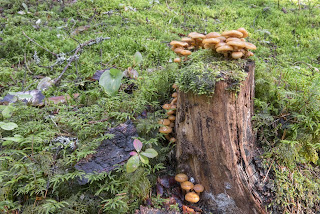
Pic of honey fungus on a rotting tree stump
Honey Fungus on a rotting tree stump

The honey fungus has spread from garden to garden – just as toxic pricing and anti-competitive practices have spread from continent to continent, country to country and company to company.

When honey fungus brings a tree down, it’s the uppermost branches that take the biggest crash of all.

Can we plant a new tree? The ground remains toxic. There are no effective chemicals. The only effective remedy is to excavate and destroy. Burn all the infected root and stump material.

To stop the fungus spreading you need to build a physical barrier and bury it deep in the soil. Very few trees are resistant to honey fungus.

Maybe tech has the solution? Hasn’t it got the solution for everything according to all the hype? I recently revisited Bristol’s Millennium Square. The metal Energy Tree looked somewhat sad after its European Green Capital heyday. I can’t help thinking that it’s a bit like Rules-based Machine Translation (RMT) or Statistical Machine Translation (SMT). They are now abandoned for the shiny new Neural Machine Translation (NMT).

A metal tree is no match for a real tree's healthy foliage however shiny

NMT isn’t a match for strong, healthy human translation despite the hype. And that metallic Energy Tree is no match for the gloriously healthy foliage of a Horse Chestnut.

The moral of this tale for those in the uppermost branches of the translation industry at GALA, EUATC, ELIA and FIT? Watch out for the translation equivalent of honey fungus. Deal with the problems at the roots, even if you feel that they are not your problems... YET.

References:


Karen Andrews is a freelance French to English translator, transcreator, content writer and editor. She has a strong background in global marketing.

Email Karen for further information via karenanglicityen@gmail.com in French, German or English.