For sheer
entertainment value it has to be 10/10. No, this is not a review of a West End
Show, but a language and culture class at Europe House in London.
The Dutch readily
concede that their language is not the most melliferous on the planet. If you
want honey in your ear, better study Italian. Judging by Thursday’s taster
class, the Dutch do not take their language too seriously. They certainly know
how to make learning about language and culture FUN.
Swamp Language
First up was
Gaston Dorren, author of Lingo: A
language spotter’s guide to Europe. The title of his talk had worried me in
advance. Dutch: the Sound of the Swamp sounded
derogatory. A frog peered out from the screen at us all.
Frogland
All became clear.
Gaston showed how the story of Dutch began in a swamp with detailed maps.
Clever drainage and building up hillocks improved the landscape. The Dutch use Frogland as a term of endearment for
their country.
 |
| Gaston Dorren presents sign interpreters with Dutch gender challenges |
Size v. Influence
Gaston joked about
the size of the Netherlands. At one seventh of the size of the UK, it could fit
into Scotland and get “mislaid” up there. He explained how Dutch appears in the
top 1% of the world’s languages. Dutch has 24 million speakers. It is the
twelfth most widely used language on the internet. It is the fifth most
commonly requested language in job vacancies according to a 2013 UK survey.
History
How did the
Netherlands become so influential? It became populated and prosperous at a time
when Northern Germany was in economic decline. Gaston acknowledged a “shameful
colonial past”. Standing in London before a largely British audience, he had no
fear of anyone throwing stones on the subject. He reduced the historical wars
between our two countries to wins, losses and draws as though they were
international football matches. Our two nations do so love the beautiful game.
Dialects
The country’s
geography helped create extraordinary linguistic diversity. There are very
different dialects. A dialect on one side of this small country is unintelligible
on the other side. You can still hear traces from the three original tribes.
Gaston attributed their retention to the population’s lack of mobility. They
didn’t travel much for 1500 years. If you need a huge pole to cross all the wet
bits, well, you don’t get very far from home.
Pronunciation
Dutch has a reputation
for difficult sounds. Gaston admitted that getting your pronunciation wrong
could cause difficulties in the kitchen. You might get your eggs and onions
muddled up. Disastrous.
The infamous “g”
It is the “unpleasant
g” sound produced in the throat that is the real issue for English-speakers. Henriette
Louwerse of the University of Sheffield tackled the “g” issue head on. No room
for any delicacy. Dutch is loud. Seconds into the language class, she had the
whole room grazing their throats to throw up the correct sound.
 |
| Henriette Louwerse demonstrates Dutch sounds |
Attitude to language
Henriette
continued the humorous tone set by Gaston. She regaled us with the incredulity
of her compatriots that she taught Dutch language and literature in Britain. The
Dutch are proud of their country, art history, football and sports. They have
never won a Nobel Prize for Literature. While they expect refugees to learn
Dutch to integrate, Henriette described the attitude as “mercantile” rather
than emotional.
Badges
The Dutch will
insist on speaking in English to her students however. She has to equip them
with humorous badges to overcome the problem: “I speak Dutch. Can I do it with you?”
Goal
Obviously,
Henriette could not teach the whole room her native tongue in just 30 minutes.
A better target was to be able to pronounce Dutch footballers’ and football
managers’ names correctly. We all repeated the various sounds after her.
Intonation
Henriette
demonstrated the rising intonation of Dutch questions. The intonation may sound
exaggerated to an English ear. It is important if you want a Dutch person to
understand that you are asking a question. Otherwise you risk not getting what
you want.
Tactile
In the
Netherlands, you do not greet someone from a distance. The words alone are not
sufficient. The Dutch are a tactile nation. You must go right up to them, look
them in the eye and shake them firmly by the hand as you greet them.
 |
| Henriette explains how easy Dutch is |
Catching Enthusiasm
Otherwise Dutch is
apparently easy for English speakers. Henriette proved this to us by having us
decipher two printed conversations on a leaflet. No problem. Henriette is the
kind of teacher you can’t disagree with. Her enthusiasm is catching.
Dutch Embassy
This great
language taster event was organised by the Dutch Embassy with Europe House’s
language officers Paul Kaye and Stephen Turkington. Paul gave particular credit
to Lauren Harris at the embassy.
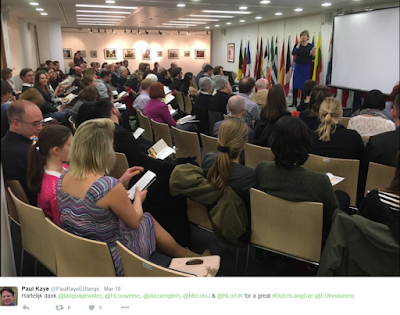
 |
| Attentive full house at Dutch and Frisian taster classes |
At the break they
laid on Dutch beer and delicacies. They catered for everyone. The
ground floor venue gave easy access for a knowledgeable disabled guest. Two BSL signers interpreted for two deaf visitors amid the full house. It
can’t have been easy interpreting some of Gaston and Henriette’s vocabulary - never
mind the speedy and humorous delivery.
Every six months,
Europe House stages an event celebrating the language and culture of the
current holders of the EU Presidency. Slovakia will hold its first-ever Presidency of the EU next. The Dutch have set the bar very
high for the Slovak Embassy.


