
 Old manuscripts, books and letters can open a window on the past even in the digital age. While there is no guarantee that last year’s ebooks and apps will open after the next software update, the pages of a centuries-old book will still turn tomorrow. Much of the past is available digitised online today. Can it beat the thrill of seeing the original manuscripts for yourself? Let me tell you about a very special library and its treasures tucked away in London’s Piccadilly for Libraries Week (8-13 October 2018).
It was a thrill to discover the treasured books and manuscripts of Carl Linnaeus or Carl von Linné last week. Dr Isabelle Charmantier, Head of Collections, gave a talk on the famous Swedish botanist and his classification system at the Linnean Society of London. I followed the talk with one of the society’s regular treasure tours.
Linnaeus was a fellow bibliophile. It must have been purgatory not having access to his professor's library. He even drew a map of his professor's home showing the long corridor from his room to the library in the opposite wing. His late night reading and note-taking caused consternation. The professor's wife worried about the house being burnt down if he fell asleep by candlelight. The professor investigated. Linnaeus gained access to the library.
I marvelled at Linnaeus' ability to classify so much information in a pre-computer age. I admired his neat handwriting - a lost skill for many today. His precocious taxonomic talent and intentions were obvious in his twenties.
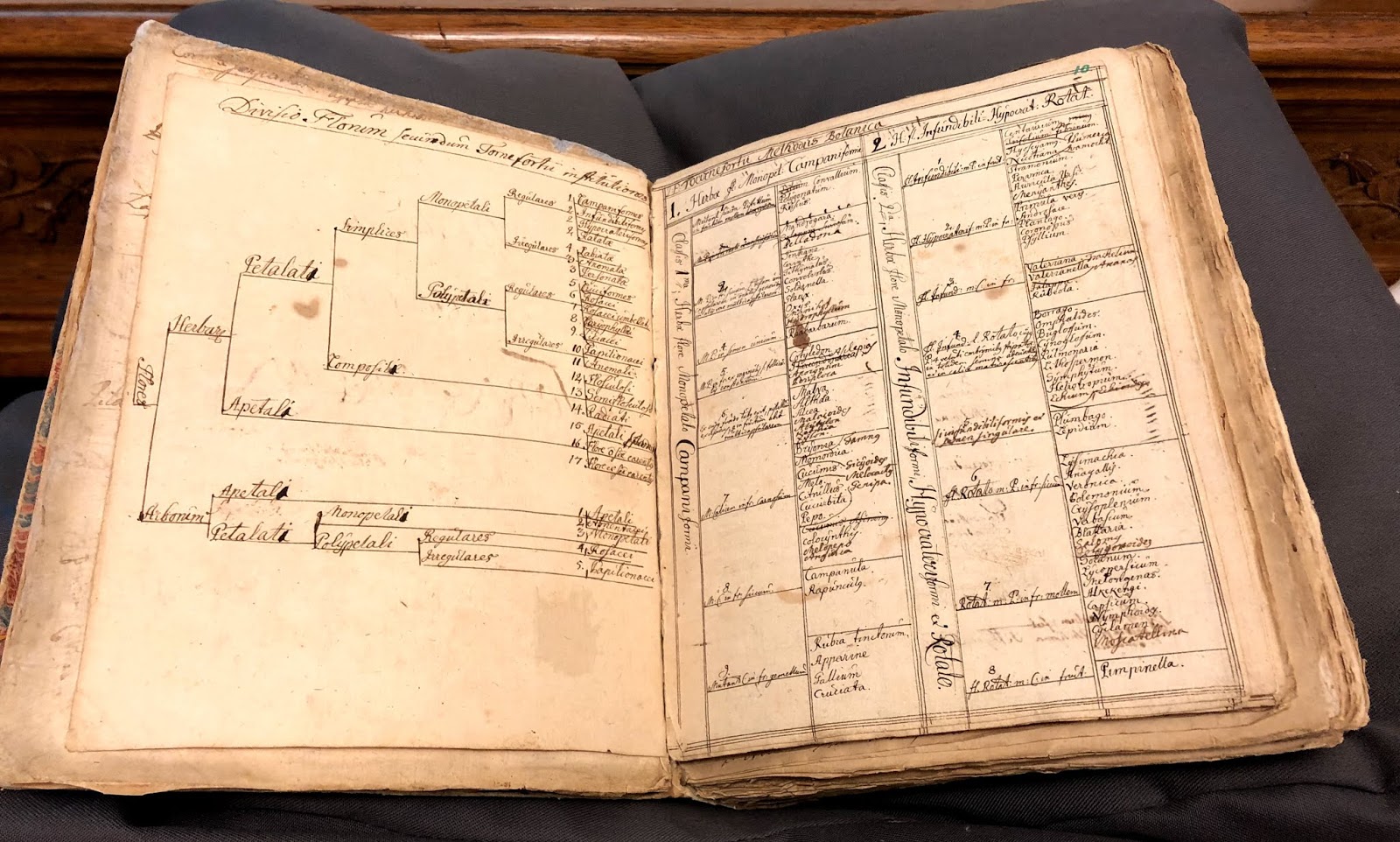 |
| Facsimile of neatly handwritten classification records |
The manuscripts on display at the seminar were facsimiles. The real treasures are held in a special vault in the basement. It houses Carl Linnaeus' botanical and entomological collections, along with his own library's books, papers and letters.
 |
| Inside of the vault at the Linnean Society of London on the treasures tour |
How did the Swedish botanist's collections end up in London?
When Linnaeus died his wife offered his collections for sale as urged by the botanist to cover dowries for their daughters. Joseph Banks of the Royal Academy and Kew expressed interest. Linnaeus' son protested and took good care of the collection until his own death.
 |
| Portrait of James Edward Smith in the library |
Joseph Banks was no longer interested. He urged the botanist James Edward Smith to acquire the collection instead. There followed a series of letters between James Edward Smith and his wealthy wool merchant father. He gradually wore his father down and the Linnean Society of London was founded.
 |
| Our guide turns the page of one of two original manuscripts |
Our tour guide for the day was the Linnean Society's retired librarian. She shared her fascination with her former charges. The Linnean Society is very grateful to the Mellon Foundation for its donations to help digitise and conserve the precious collections.


