The University of Westminster staged its first Difference Festival this week. Andrew Linn, the Pro Vice-Chancellor and Dean of Social Sciences and Humanities, described it as a 'Festival of the Mind'. The various talks celebrated difference in one way or another.
I attended the 'Discover Swedish Language and Culture' talk. Christina Nilsson promised to demonstrate that there is much more to Swedish culture than ABBA, IKEA and pickled herring.
The presentation began with a flurry of pictures and figures, as Christina set about keeping her promise to reveal Swedish society, mentality, language, food and music.
Country and Population Facts
 |
| Sweden's place in Europe |
Sweden has 10 million inhabitants in the 5th largest country in Europe (in terms of land area).
85% of Swedes live in cities.
The capital is Stockholm. 2nd city Göteborg and 3rd city Malmö.
Less than 3% of the land is built upon.
Sweden is long and thin: 1,574km long to be precise.
69% of the country is forest.
15-17% were born in another country.
Other Residents
More than 300,000 elks
200,000 reindeer
 |
| Elk on hillside with forest background |
Stockholm and its islands
Water, water, everywhere.
Stockholm is built on 14 islands.
It has 57 bridges.
The Stockholm archipelago consists of 30,000 small islands.
 |
| Stockholm surrounded by water |
Swedish Culture
Murders? With exported TV series such as Wallander, Beck and Girl with a Dragon Tattoo... it might appear that Swedes are a murderous bunch.
 |
| Sweden: multiple crime scenes - fact or fiction? |
Why are such crime dramas so popular? The long, long, dark nights...
Nordic Noir authors wanted to point out what is wrong with Swedish society.
Food
Fika - essential coffee and cake as often as possible. Whether meeting a friend or at work, both in the morning and the afternoon, Fika is not to be missed.
 |
| Fika: coffee and a bun |
Music
Swedes are proud of their music. Christina ran through a host of musicians to prove that Sweden has more than ABBA to offer.
3rd largest exporter of music.
The Eurovision Song Contest is a really big deal in Sweden. The selection process goes on for weeks with elimination rounds and second chances on the way to the final. The whole country watches on TV. Swedes take Eurovision seriously. Well-known stars take part. Only Ireland has won more Eurovision contests than Sweden.
Swedish Inventions
Swedes have shared an impressive range of inventions with the world.
Examples include the dialysis machine, pacemaker, zip, ombudsman, 3-point seat belt, Tetra Pack, Minecraft, Spotify, Candy Crush, Skype, safety match, etc.
 |
| The zip: a Swedish invention |
Swedish Society
Swedes rely on the State to provide for them - childcare, maternity pay and pensions.
They are happy to pay high taxes.
They expect the State to look after them when they need help.
The State Pension is set at 80% of your salary.
Childcare costs just £100 per month. Sweden has the highest proportion of working mothers as a result.
Law of Jante
Swedes expect an egalitarian society. The Law of Jante
can help you to understand Swedish mentality:
1. You're not to think you are anything special.
2. You're not to think you are as good as we are.
3. You're not to think you are smarter than we are.
4. You're not to convince yourself that you are better than we are.
5. You're not to think you know more than we do.
6. You're not to think you are more important than we are.
7. You're not to think you are good at anything.
8. You're not to laugh at us.
9. You're not to think anyone cares about you.
10. You're not to think you can teach us anything.
These 'rules' can also have a negative side. You should not boast about personal achievements. There are strong expectations of how to behave and dress. You should think of people as a group and contribute as a group. Young Swedes are trying to break out of this mentality today.
Swedish Cultural Behaviour
Swedes have a reputation for being cool and standoffish. The Spanish even had an idiom based on them: hacerse el sueco - to behave like a Swede. They will not speak or say hello on a bus for instance. They ignore everyone.
Their straight-talking can appear rude. There is no word for 'please' in Swedish.
It is not unusual to be quiet for long periods over dinner.
Apparent 'rudeness' should perhaps be interpreted as the sign of a nation that values its privacy. Some speculated that this was influenced by the climate. The winter cold prevents you from 'hanging about' to chat. Neighbours may not live that close to one another.
A New In-word?
The craze for Danish hygge is old hat. This year's in-word is lagom according to the Media. It is another of those untranslatable words. It means 'just about right. Not too much, not too little'. The trouble is any one person's too much or too little is different. The word has its origin in sharing mead and ensuring that everyone got the same amount.
Love of Nature
Swedes love nature. They love to spend the long summer days out of the office walking in the woods, etc.
 |
| Hiker in midnight sun in Sweden |
Allemansrätten or 'right of public access' is very important in Sweden. It gives everyone the right to access the Swedish countryside.
Many Swedes have summerhouses in which they like to stay at weekends. Often these summerhouses are not that far from their main homes. It is also common to own a boat.
Midsummer celebrations are as big as Christmas in Sweden. Swedes still celebrate Pagan festivals.
 |
| Swedish Midsummer Celebration |
Swedish Language
Christina explained that Swedish is very similar to Danish and Norwegian. It is more similar to English than we might expect. Danish is viewed as the more difficult language.
A list of similar looking and sounding words appear on screen followed by a host of false friends. The word gift caused some laughter - it means both married and poison.
The evening ended with an invitation to sample further cultural differences and languages. In addition to Swedish, the University of Westminster also offers language courses in Arabic, Bulgarian, Cantonese, Chinese, Croatian & Serbian, Danish, Dutch, Farsi, Finnish, French, German, Hungarian, Italian, Japanese, Norwegian, European Portuguese, Romanian, Russian, Spanish, Swedish and Turkish.
Karen Andrews is a freelance French to English translator, transcreator, content writer and editor. She has a strong background in global marketing.
Email Karen for further information via karenanglicityen@gmail.com in French, German or English.

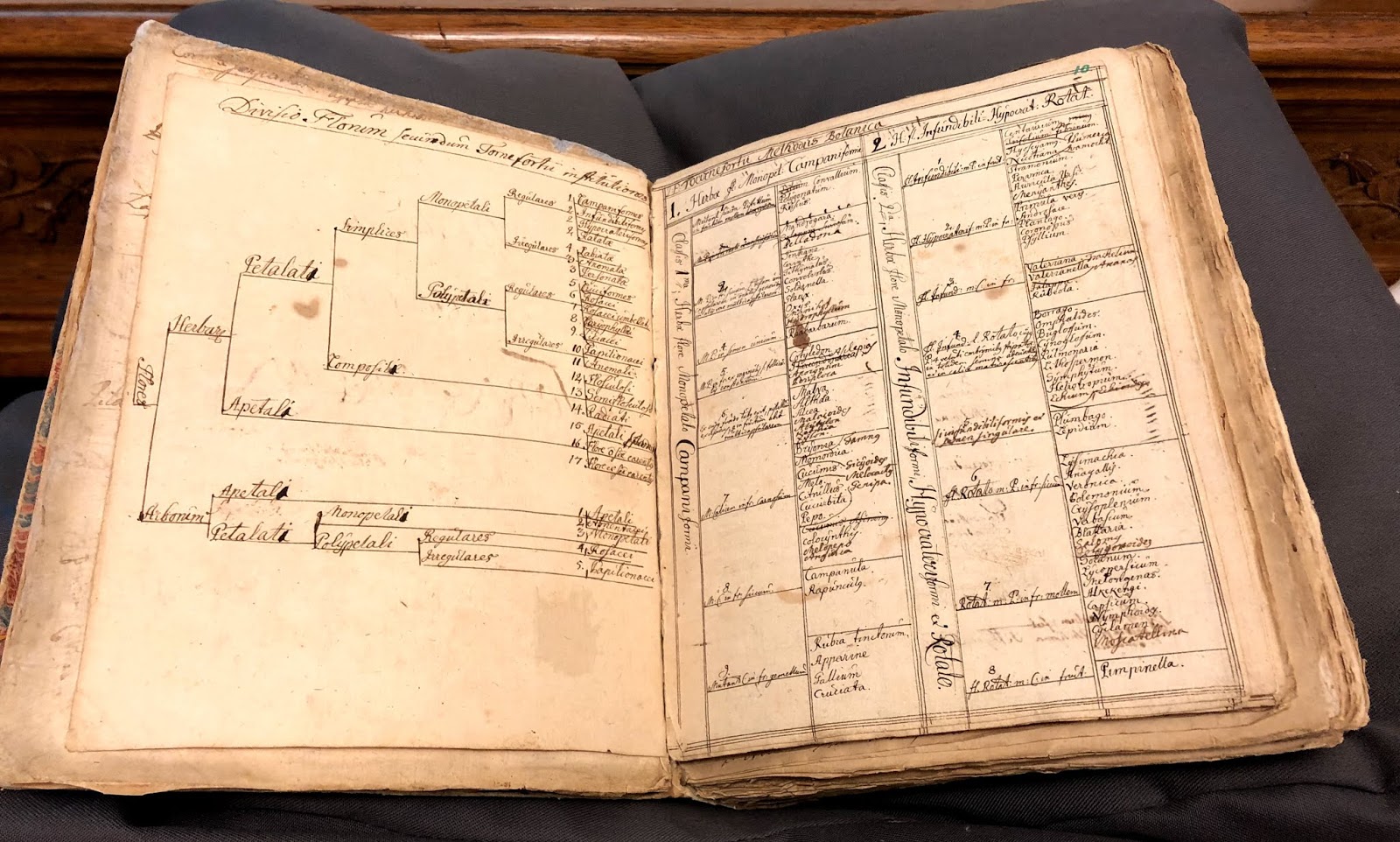
 Old manuscripts, books and letters can open a window on the past even in the digital age. While there is no guarantee that last year’s ebooks and apps will open after the next software update, the pages of a centuries-old book will still turn tomorrow. Much of the past is available digitised online today. Can it beat the thrill of seeing the original manuscripts for yourself? Let me tell you about a very special library and its treasures tucked away in London’s Piccadilly for Libraries Week (8-13 October 2018).